


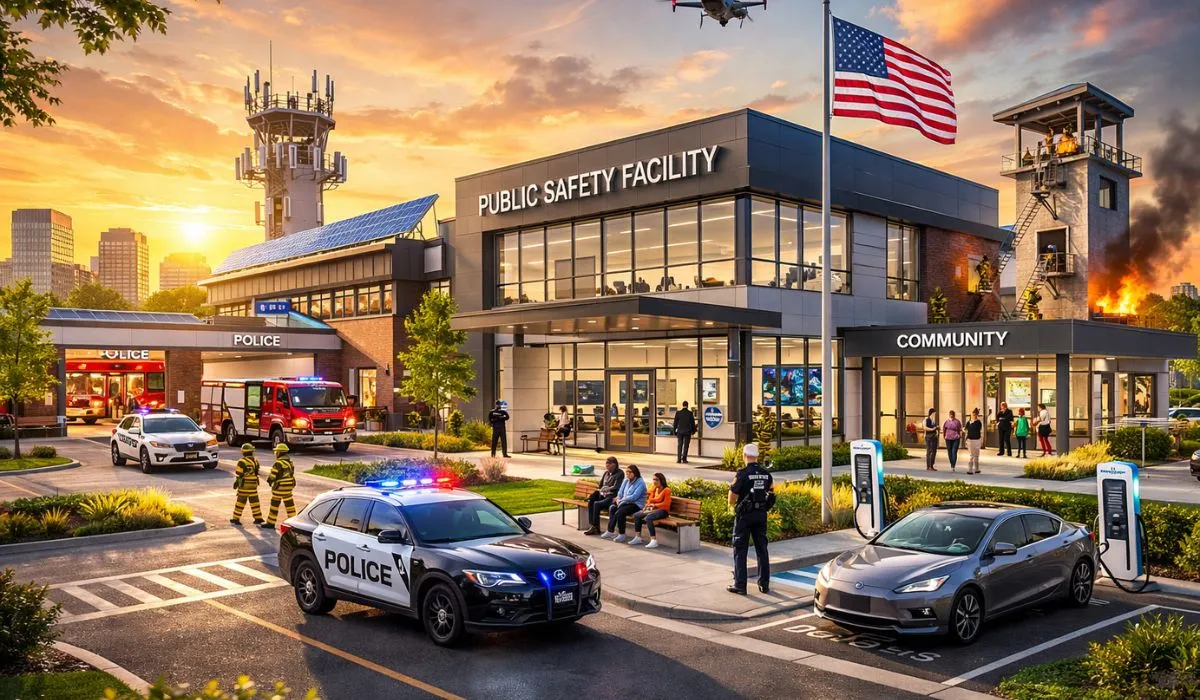
A public safety facility is more than just a government building; it is the backbone of a community’s emergency preparedness and protection. Such facilities often combine essential services including police, fire, emergency dispatch and emergency management offices under one roof.
The aim of these public safety operations is for them to run as a well-oiled machine and operate in the most efficient manner possible – and for all these pieces to be so well coordinated. Modern cities must deal with increasingly complex challenges, ranging from increasing population density and types of emergencies.
A purpose-built public safety facility allows agencies to respond in a timely manner, swap information effortlessly and manage incidents efficiently. It is intended as much to serve officers and firefighters as it is to be a place of safety for residents seeking help or information.
Building One Innovation at a Time
In past decades, police and fire departments were separate entities, oftentimes separated by multiple locations. However, this method was successful with smaller populations, but proved less useful as cities expanded. Inefficient integration led to slow responses, overlapping costs and legacy systems.
Cities are reevaluating this model today. The Hennepin County Public Safety Facility in Minnesota and the City of Mesa Public Safety Training Facility in Arizona showcase how local governments are embracing integrated, sustainable and technology-enabled designs that provide for immediate and long-term needs.
These buildings are designed to endure for decades and built to LEED standards, with flexible layouts that adapt to future growth, and new digital systems that facilitate emergency communication and coordination.
Core Activities Inside a Public Safety Facility
Historically, public safety is a multi-faceted concept that may incorporate several key elements. These buildings house the operations of police departments that patrol, investigate and do outreach in communities. When fire departments are combined with emergency medical services, they generally share ground space and can talk to each other at a moment’s notice when things have gone right or wrong with the treatment.
In Minnesota, facilities such as the South Metro Public Safety Training Facility and the North Metro Regional Public Safety Training Facility take it even further by embedding training programs directly into operations. Such centers enable police officers, firefighters and paramedics to train in realistic settings, preparing them for a variety of emergency situations.
Acting to Gain in Public Safety Buildings
Training complexes play a indispensable role in education readiness and ability of the officials that respond to emergencies. Strong examples of how training and operations can co-habitate are the Gilbert Public Safety Training Facility in Arizona and the MCC Public Safety Training Facility in Michigan.
In Gilbert, the city put its money into a modern campus with simulation labs as well as driving courses and firetraining towers — allowing continuing education for new recruits and veterans. The MCC facility is a state-of-the-art training center for students seeking degrees in public safety, bridging the gap between education and practical service.
Through a combination of academic study and field-based training, these facilities help to ensure that communities can be protected by professionals who are both qualified and trained to respond appropriately to emerging threats and hazards, whether they are posed by natural disasters or complex criminal events.
Modern Design and Sustainability
The design of a public safety facility today is much more than building offices and garages. Sustainability, accessibility to communities and integration of technology now become the priorities in cities.
Such as the City of Surprise Public Safety Facility in Arizona and the Santa Monica Public Safety Facility in California, which utilize green building materials and incorporate solar power systems and HVC technologies that significantly reduce environmental impact with lower long-term operational expenses.
LEED (Leadership in Energy and Environmental Design) certification has become an aspirational benchmark for many public projects. The Redmond Public Safety Facility in Oregon, for instance, has solar panels and electric vehicle charging stations for staff and the public. These upgrades signal a growing understanding that environmental stewardship and public safety can be complementary.
Community Benefits of Co-Located Facilities
The operational advantages of bringing multiple departments under one roof are obvious. It encourages communication, minimizes duplication and lessens response times. In addition to logistics, co-located facilities also help build community trust.
When residents can fill out a police report, participate in a safety workshop or request public records all at one central location, government services become accessible and there is transparency. In Minnesota, for instance, the Big Lake Public Safety Facility Project will merge City Hall, the Police Department and the Public Library into a single 55,000-square-foot structure.
The co-location under one roof improves efficiency while establishing a civic community for families who can participate in programs and feel connected with government.
Case Study: Hennepin County Public Safety Facility
The modern design of the Hennepin County Public Safety Facility building in Minneapolis speaks to community needs. It is both a jail and an administrative center for law enforcement. The facility, spread across two connected buildings — the County Public Safety Facility and City Hall — houses people who are awaiting trial, and delivers key services to the justice system.
There is ready access to the site through public transport for residents, and its digital jail roster also updates every hour so that the information reaches citizens of Baltimore as more open source material. Like many large facilities, Hennepin County also informs citizens about scams that target inmates’ families.
This facility is an example of the next generation of public safety infrastructure, striking the right balance between openness, accountability and serving the community.
Integrating Technology in Modern Facilities
Technology is changing the way public safety facilities function. With direct connectivity from advanced surveillance systems to real-time data sharing, modern infrastructure allows for more efficient and coordinated responses.
The North Metro Regional Public Safety Training Facility utilizes simulation technology to replicate complex emergency situations. Officers can practice de-escalation, fire response and disaster coordination in controlled environments that approximate real-life conditions.
In a similar way, new facilities throughout the U.S. now have dispatch centers that are all integrated and share information instantly among multiple agencies, bridging communication gaps during emergencies and leading to better overall outcomes.
Financial and Planning Considerations
Constructing a public safety center is a huge investment. Cities typically finance construction with bond measures, grants or lease-revenue financing. For instance, Big Lake, Minnesota approved a budget of up to $33 million for its new facility and used lease-revenue bonds instead of new taxes to minimize the burden on residents.
Projects like this require years of planning, feasibility studies and community input. In addition to ensuring that current demand is met, future growth and evolving threats must also be anticipated. A well-designed facility will need sufficient flexibility to respond to changes in technology, security practices and service delivery requirements over time.
Well-publicized rants and early reviews from real users
When residents see the tangible benefits to public safety facilities, they tend to strongly favor them. In Redmond, residents applauded the city’s transparent process and focus on sustainability, also pointing out that the new facility has a modern vibe and instills civic pride.
A resident from Big Lake said they liked that investing now plays well into the future and putting City Hall, the library and the police department in one area makes it easier to access services with kids. These upgrades are also worthwhile to law enforcement officers and other firefighters. A training officer with the South Metro Public Safety Training Facility says that better simulation environments have made programs more realistic and effective now than they have ever been.
These experiences illustrate the critical need for long-term plans — investing in well-thought-out, forward-looking facilities that benefit both public and professional users.
Comparing Regional Models
Diverse approaches have been undertaken in various regions to build public safety facilities. City of Mesa Public Safety Training Facility focuses on extensive integration of police, fire and emergency medical service offering classrooms, live fire training areas and mock urban environments.
In the opposite approach, the Santa Monica Public Safety Facility integrates police operations with civic engagement for open spaces of public education and community events.
While their goals — safety, efficiency and preparedness — are similar, the design choices they make reflect local priorities and community expectations.
Designing Public Safety for the Human Element
A public safety facility is more than just the physical space of architecture and equipment — it embodies the people who work within its walls. These spaces keep officers, firefighters and emergency responders safe in the performance of their duties.
Contemporary designs integrate wellness amenities like fitness rooms, abundant natural lighting and tranquil recovery zones. This emphasis on health and morale mitigates burnout and increases job satisfaction among public safety professionals – it ensures that communities receive the highest quality service.
The Future of Public Safety Institutions
Technology will continue to evolve, as will population and climate challenges; the facilities that support public safety need to adapt right along with them. Future designs will probably focus on resilience, renewable energy and digital integration.
Virtual training environments, smart building management systems and AI-assisted emergency dispatching will be that common tool. The Hennepin County Public Safety Facility and the Gilbert Public Safety Training Facility are already showing how flexible buildings can enable these innovations.
In addition, collaboration among municipalities, academic institutions and regional training centers will increase. A model for these types of systems can be seen in shared-use facilities like the MCC Public Safety Training Facility, which promotes education and professional development while providing mutual benefit to students as well as the broader community.
Conclusion
Public safety facilities are the backbone of safe, resilient communities. They are a collaboration of government workers and citizens to keep services running smoothly.
With projects ranging from the Hennepin County Public Safety Facility to the Big Lake Public Safety Facility Project, these facilities exemplify how thoughtful design, modern technology and sustainable best practices can transform public safety for future generations.
When cities expand, investing in such facilities is more than an infrastructure decision; it’s a promise of trust between the public and government to be prepared and work for the community’s future.
FAQs
What does a public safety facility look like?
The public safety facility is a government-owned building that contains important emergency services like police, fire and emergency operations.
Why are cities constructing new public safety buildings?
They intend to enhance response times, lower operational costs, and supply modern, energy-efficient facilities that can serve increasing public safety needs.
What makes modern buildings like the Hennepin County Public Safety Facility so unique?
They are capturing advanced technologies, sustainable features and community accessibility from one integrated structure.
How is public safety training facilities unique?
Training facilities like Gilbert or Mesa focus on hands-on learning and simulation to help emergency personnel prepare for real-world challenges.
How does sustainability affect facility design?
Newer construction adheres to LEED standards, incorporating energy efficient systems, green elements and solar panels into their designs to minimize environmental degradation.
What are the benefits local residents derive from these facilities?
They enhance the safety of our neighborhoods, allow for quicker responses to emergency situations and other matters, and can be a storied access point for essential city services all in one civic location.
