
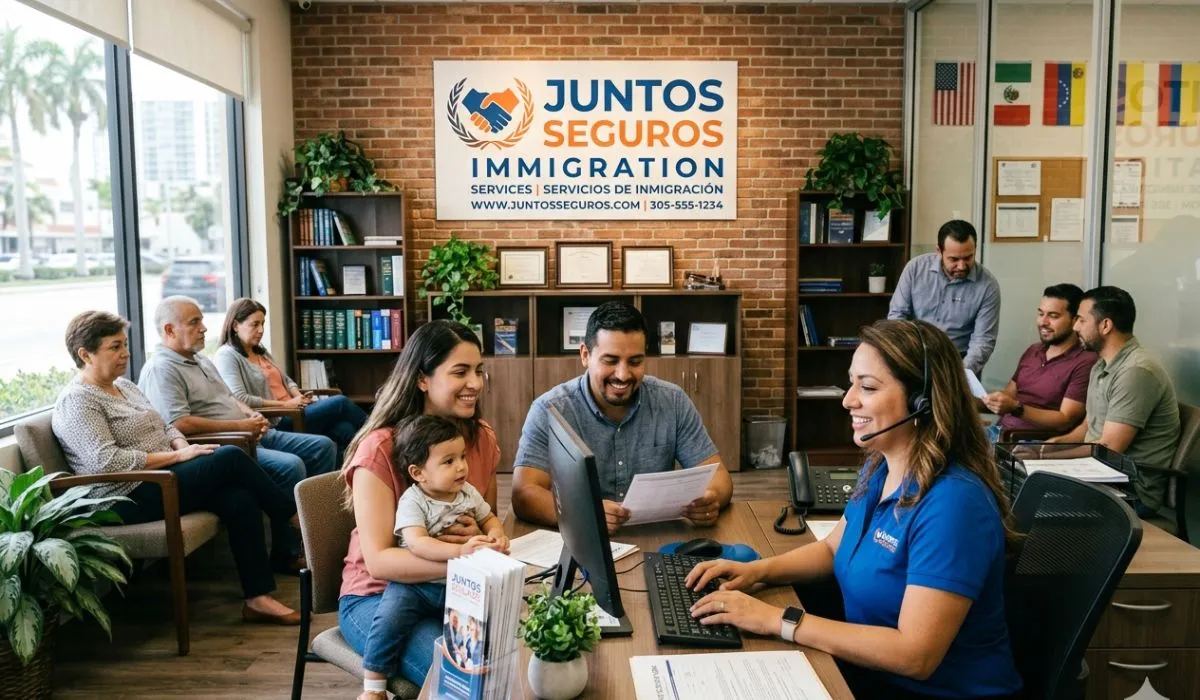
What Is Juntos Seguros Immigration?
Gathered Safe Together, is a community driven digital platform that arose to help immigrant communities stay updated on immigration enforcement, specifically ICE (U.S. Immigration and Customs Enforcement) activity. Real time reporting and shared mapping also allowed Juntos Seguros immigration to keep people aware of potential risks.
The platform was designed to work as a safety network, not a legal service, providing individuals with the tools to support each other and navigate systemic risks. Rather than rely solely on traditional media or government-issued alerts, Juntos Seguros enabled users to submit reports of ICE sightings anonymously, creating a live and interactive immigration map.
It was widely called the juntosseguros immigration map, which users could consult to assess potential risks along their neighborhoods, commuting routes or community spots. While the platform once provided robust capabilities, recent reporting suggests combining juntosseguros. com has gone dark, at least in the capacity it used to exist.
Community Map & Alerts — How Juntos Seguros Worked
At its core, Juntos Seguros involved three ingredients: information, confidence and assistance. Users could anonymously report sightings of ICE, including where agents were spotted and when suspicious activity took place, or even when a vehicle seemed to be affiliated with ICE. The user submitted reports were collected and partially verified by the platform.
That information was published to an interactive map that community discussions would end up referring to as the juntos seguros immigration map USA. The core function of the platform was a map. It mapped locations where ICE activity had been reported, allowing users to choose whether to evade certain areas, alter their travel plans or adjust their everyday work or school routine.
Since many immigrant families are afraid of chance encounters, the map provided a way to predict potential risk. Along with the mapping feature, Juntos Seguros also offered links to legal and financial resources. It was intended not just to serve as a warning system, but also as a repository of information about rights and where to obtain legal help and how to ready your finances for disruptions caused by immigration.
In that sense, the platform overlapped on a number of safety fronts: physical consciousness, legal awareness and financial preparedness. Another key strength was its bilingual availability. The content itself was produced, not just in English but also on alerts, in Spanish and as such made the platform much more inclusive, especially within Latino immigrant communities by eliminating language barriers for critical information.
Why Juntos Seguros Mattered
Juntos Seguros is extremely important, especially at times of intensified immigration enforcement. For many undocumented people, or mixed status families — households with members who have and do not have legal immigration status — living day to day carries hidden risks. The fact that we would know ahead of time with a community driven map helped me manage anxiety and not feeling insecure.
First, it provided situational awareness. Rather than relying on speculation or lagging news, community members could serve as real-time reporters of what they were seeing. This collective consciousness enabled others to quickly decide when to venture out, which streets to avoid and how to navigate daily lives with more care.
Second, the platform built community trust. It also promoted cooperation and better bonds between neighbors by enabling neighbor-to-neighbor information sharing. Users were no longer passive spectators, they became active collaborators in a collective initiative to help protect one another. Juntos Seguros thus operated not only as a tool, but also as a network of solidarity.
Third, it offered concrete legal and financial support. The platform recognized that fear of ICE enforcement is often associated with economic hardship. Lost wages, legal fees or detention can have a grave impact on a family’s financial health. Juntos Seguros sought to strengthen resilience, not just reduce risk by providing access to legal guides and financial education.
Challenges Shutdown & Sustainability
Even though Juntos Seguros had a meaningful mission, it faced many challenges. The service initially closed sometime in mid 2025, according to reports from various sources. As to the reasons for this closing, they serve as a reminder of the challenges facing homegrown digital efforts.
One major challenge was funding. Running a live mapping platform with real time reporting is an expensive process requiring human resources. Juntos Seguros had almost entirely community-funded work without featuring any long-term institutional support. As time passed, the costs of hosting, moderation and verification were hard to sustain.
A further problem was that of data accuracy, and verification. There is always a risk of incorrect or misleading reports, with crowdsourced platforms. Because the platform was based on user submissions, not all reports could be accurate, duplicated or misunderstood. False alerts can cause unnecessary fear or confusion, which puts a particular responsibility on the platform to be accurate.
Privacy and security were other concerns. Collecting reports that are anonymous still poses risks around sensitive information, especially for marginalized communities. Platforms without proper security systems to protect users, can be the victim of cyber attacks that expect capital investment. Political pressure might also have contributed to some of the platform’s challenges.
Alternatives Emerging After Juntos Seguros
After the closure of juntosseguros. com, immigrant communities started looking for other tools to make up the difference. Another similar tool is ICE Location Tracker, or Alertas Juntos, which enables members of the community to anonymously report ICE sightings.
It includes a heatmap that reflects the concentration of reports and potentially where enforcement activity may be more prevalent. While there are many other applications and platforms, few ever truly captured the grassroots community spirit of the Juntos Seguros we created.
This shutdown highlights an important lesson: While community tools have become a powerful vehicle for enacting change, they must also take sustainability, verification systems and legal risk into account if they want to continue to be effective over time.
Real User Reviews & Experiences
To gain a practical sense of the Juntos Seguros immigration tool’s real-world effect, it helps to hear people describe their experiences using it. Luis M., a Texas user, said that he used to rely on hearing about ICE checkpoints through social media gossip. After using Juntos Seguros, he said that they received more accurate and timely alerts to help him avoid stressful encounters.
Another user, Ana P. in Florida, wrote that her family looks at the map every morning. Before they leave home for work or errands, they check the juntos seguros immigration map to decide whether they need to adjust their route.
Maria L. in California liked the bilingual design. Her parents, who don’t really know how technology works, get up-to-date notifications on the app and is passively getting explanations through the website to understand what’s going on.
In another example, David R. of New York described how a map alert pushed him to take a different route while walking. He thinks that decision likely kept him out of a region where enforcement activity had been reported, which allowed him to let his guard down.
These are two important things that I take from these testimonials: The real time mapping is useful in practical sense, and provides emotional sense of belonging to a community that cares for one another.
The Benefits and Takeaways of Juntos Seguros
The original platform no longer functions in that capacity, but the concept behind Juntos Seguros immigration is still necessary. There are important lessons to be learned from its legacy regarding community focused technology for vulnerable populations.
To begin with, grassroots technology can fill critical information voids. Citizen powered platforms can support where official channels may be unable to deliver local timely updates. Juntos Seguros showed that communities can build tools to protect each other without large support from institutions.
Second, sustainability is essential. Passion alone is no longer enough to build successful community platforms in the long term. Trust needs stable funding, legal systems, a secure tech infrastructure and an adequate system for verification.
Third, verification is critical. There is a close link between trust and accuracy. Without careful verification of reports, the map might end up sowing confusion, not safety. Validating carefully will be the critical counterpart to great-speed reporting on future platforms.
Fourth, privacy should continue to be a priority. It is important to protect identity and personal data since users can be in sensitive or uncertain situations. Transparent data policies, high-level encryption, and minimizing data collection are some key practices.
In the end, the platform showed us that solidarity is powerful. The original site may have had its struggles, but the concept is still alive in new versions today.
Why Juntos Seguros Maters Today 2025
And in 2025, conditions to immigrate and be enforced against have not become simpler; too many families still face limbo.Theige In these years, there can be no question that it is right to want a chance at legal status. In this context, Juntos Seguros-type immigration tools are still very much needed. Although a specific instance may no longer be functioning, its idea lives on and comes to new systems and community networks.
For immigrant communities access to a map based alert system is more than just data. It gives a common framework for safety. The immigration map concept of juntos seguros is still powerful, because it is localized, community driven and directly tied to our daily lives.
At the same time, there’s a balance; users today should be cautious and informed. Because juntosseguros. With some other things shutting down, such as com Recently going back to only one tool, that can be very risky. Platforms like these should be used in conjunction with dedicated legal organizations, rights education bodies and trusted local community networks.
Community alerts are a supplement, not a substitute, for professional legal advice or official rights based services.
Community Driven Immigration Alert Tools: Best Practices
- Interpret alerts as early signals rather than absolute facts. Treat each report as potentially useful but verify information with trusted local sources like legal clinics or rapid response networks before acting on it, especially for major decisions.
- Share reports responsibly. If you see and want to report an ICE sighting, always give clear factual information such as the time and a brief description of the vehicle while avoiding ANY personal or identifying language.
- Protect your privacy. Secure internet connections, do not share your personal data and familiarize yourself with how the platform handles submitted reports.
- Integrate the tool with legal resources. Stay informed through the map, but also make sure you have contact information for know your rights organizations, immigration attorneys or local support groups.
- Strengthen community networks. Urge local organizations, churches or worker groups to take a role in verifying information and supporting each other.
- Prepare for possible outages. Since platforms can sometimes go offline, as demonstrated by Juntos Seguros history, having backup resources and communication plans is key.
Final Thoughts
Juntos Seguros Immigration was more than a site. It represented community strength and togetherness in a time of uncertainty. By putting a shared map in the hands of ordinary civilians, it turned collective observation into collective protection.
While the original platform may be no longer fully operational, its legacy lives on in the ideas it sparked: neighbors watching out for each other; issuing alerts and sharing tips with one another; creating networks built upon trust.
For immigrant families, the idea of the juntos seguros immigration map is a stark reminder that safety often thrives through the interconnections of communities as much as through mechanisms of power that depend on official systems.
As new tools evolve and other platforms emerge, the overall lesson is clear: when communities come together, they help protect each other. Anyone who wants to know how to stay closely informed about immigration enforcement should follow community platforms, legal aid organizations and trusted rapid response networks.
FAQs
What is Juntos Seguros Immigration?
It is a community-driven platform which offers up-to-date alerts and mapping tools for immigrants to be aware of local enforcement activity.
What is the Juntos Seguros Immigration Map?
Users send in reports of ICE activity or safety concerns, and those reports show up on an interactive map that heightens community awareness.
Is Juntos Seguros offered in Spanish?
Yes, the bilingual platform aims to increase accessibility with English and Spanish content.
Does Juntos Seguros offer legal advice?
The platform isn’t a legal service in and of itself — rather, it opens the door for users to access resources and information that can help mitigate risk and uncertainty.
How reliable is the Juntos Seguros app?
The app is just for real time alerts and mapping but can still function on both during temporary outages of the website.
How does Juntos Seguros help provide financial stability?
The platform works by making sure users keep aware of the risk of enforcement so that they dont have to miss work, incur legal costs or face financial difficulties.